
CO₂ vs. CO vs. VOC: Differences and How to Choose a Gas Monitor
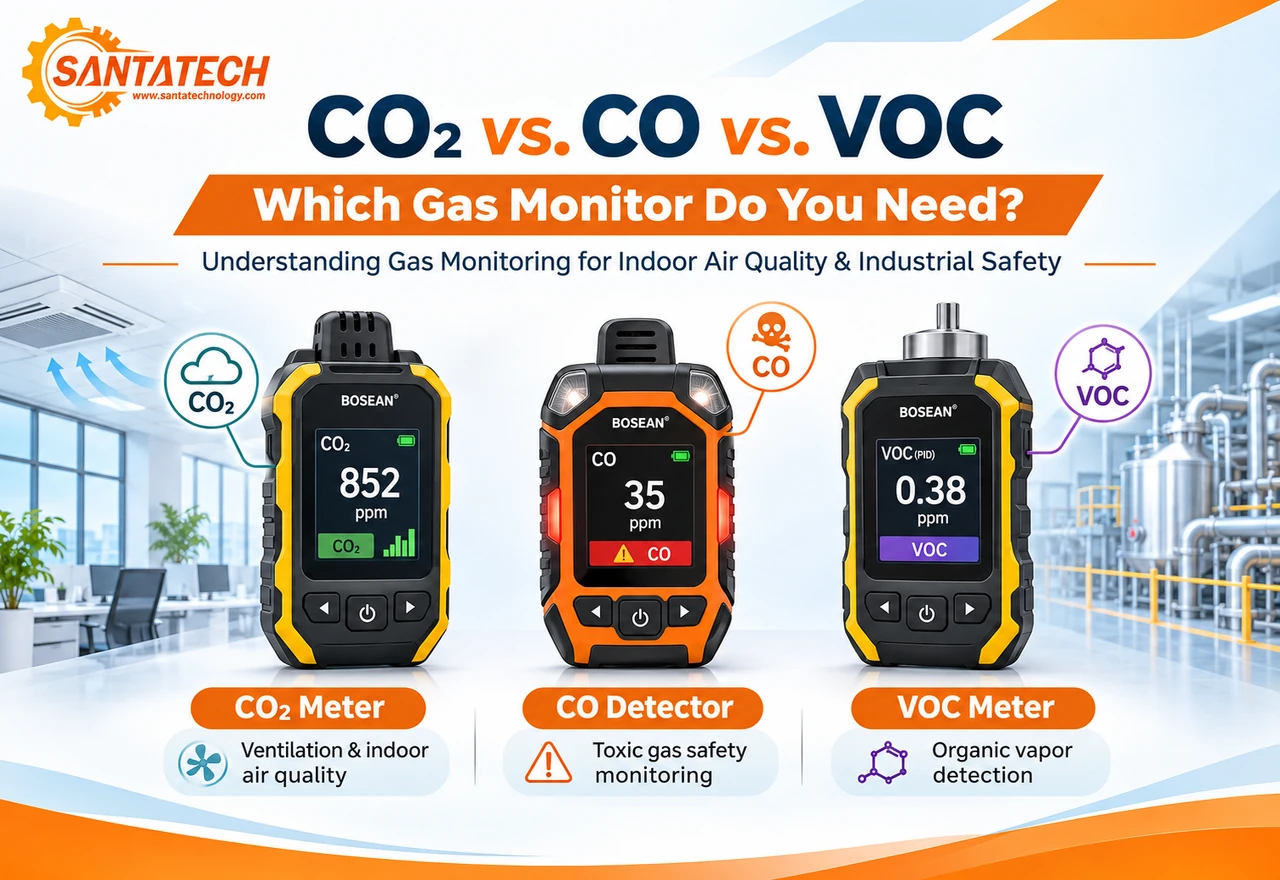
CO₂ vs. CO vs. VOC: What Are the Differences and How to Choose the Right Gas Monitoring Instrument?
CO₂ meters, CO detectors, and VOC monitors are essential instruments for assessing indoor air quality, monitoring industrial environments, and improving workplace safety.
Although these instruments all measure gases or airborne contaminants, they are designed for different purposes and cannot necessarily replace one another.
Understanding their differences helps businesses select appropriate monitoring equipment for office buildings, manufacturing facilities, laboratories, and industrial applications.
This article explains what CO₂, CO, and VOCs are, how their measurement technologies work, and how to choose the right gas monitoring instrument.
1. What Is a CO₂ Meter (Carbon Dioxide Monitor)?
Carbon dioxide (CO₂) is a colorless, odorless gas naturally present in the atmosphere. It is produced by human respiration, combustion, and various industrial processes.
A CO₂ meter measures carbon dioxide concentration in the air and is commonly used to monitor indoor environments.
What Is a CO₂ Meter Used For?
CO₂ meters are suitable for:
Monitoring indoor air quality in offices and meeting rooms
Assessing ventilation conditions in occupied spaces
Monitoring classrooms, schools, and public buildings
Supporting Heating, Ventilation, and Air Conditioning (HVAC) system management
Monitoring CO₂ levels in selected industrial processes
Tracking changes in indoor CO₂ concentrations over time
How Does a CO₂ Meter Work?
Many CO₂ monitors use NDIR (Non-Dispersive Infrared) technology.
This technology measures the absorption of infrared radiation by carbon dioxide molecules to determine CO₂ concentration.
The measurement is typically displayed in:
ppm (parts per million)
Important Considerations
Indoor CO₂ measurements can help indicate whether ventilation is adequate relative to occupancy and other conditions.
However, CO₂ concentration alone does not provide a complete assessment of indoor air quality or building safety.
A standard CO₂ meter cannot detect carbon monoxide (CO) or volatile organic compounds (VOCs) unless additional sensors are installed.
2. What Is a CO Detector (Carbon Monoxide Detector)?
Carbon monoxide (CO) is a colorless, odorless, and highly toxic gas.
It is commonly produced by incomplete combustion of carbon-containing fuels.
Potential sources include:
Internal combustion engines
Fuel-powered generators
Industrial furnaces
Boilers and combustion equipment
Fuel-burning heating systems
Vehicles operating in enclosed or poorly ventilated areas
Carbon monoxide is particularly dangerous because it cannot be detected by smell or sight.
When inhaled, CO binds to hemoglobin in the blood and interferes with oxygen transport throughout the body.
High exposure levels may cause severe poisoning or death.
What Is a CO Detector Used For?
CO detectors are commonly used for:
Monitoring carbon monoxide in industrial facilities
Detecting CO in engine and generator rooms
Monitoring enclosed or partially enclosed parking facilities
Improving safety near combustion equipment
Monitoring areas with potential incomplete combustion
Providing warnings of hazardous CO concentrations
How Does a CO Detector Work?
Many industrial CO detectors use electrochemical sensors.
These sensors generate an electrical signal through an electrochemical reaction involving carbon monoxide.
The resulting signal is used to determine gas concentration.
CO concentration is typically displayed in:
ppm (parts per million)
Depending on the instrument, additional safety features may include audible alarms, visual indicators, vibration alerts, and configurable alarm thresholds.
Important Safety Considerations
A CO₂ meter must not be used as a substitute for a CO detector.
Where carbon monoxide hazards are present, a dedicated CO detection system or appropriately rated gas detector should be selected.
The instrument should meet the relevant safety requirements for the intended application.
3. What Is a VOC Meter (Volatile Organic Compounds Monitor)?
Volatile Organic Compounds (VOCs) are a broad group of organic chemicals that can evaporate into the air under various environmental and operating conditions.
VOCs may originate from:
Paints and coatings
Adhesives and glues
Industrial solvents
Printing inks
Cleaning agents
Chemical manufacturing processes
Certain plastics and production materials
Examples of VOCs include:
Benzene
Toluene
Xylene
Ethyl acetate
Other volatile organic solvents
Different VOCs have different physical properties, toxicities, and occupational exposure risks.
What Is a VOC Meter Used For?
VOC monitors are commonly used for:
Monitoring solvent vapors in industrial environments
Inspecting painting and coating operations
Assessing emissions from adhesives and printing processes
Monitoring chemical handling areas
Investigating indoor air quality concerns
Screening for contamination caused by organic vapors
Identifying potential sources of chemical vapor emissions
How Does a VOC Meter Work?
VOC monitors may use different sensing technologies depending on the required application.
PID (Photoionization Detector)
PID technology uses ultraviolet light to ionize detectable gas molecules.
It is widely used for industrial VOC screening and measurement.
However, the detectable compounds depend on factors such as the lamp energy and the ionization potential of the target chemical.
MOS (Metal Oxide Semiconductor)
MOS sensors detect changes in electrical properties when exposed to certain gases.
They are commonly used in some indoor air quality monitors and general-purpose gas sensing applications.
However, MOS sensors may respond to several gases and are not necessarily selective for individual VOC compounds.
Common VOC Measurement Units
Depending on the instrument and measurement method, VOC results may be displayed as:
ppm (parts per million)
ppb (parts per billion)
mg/m³ (milligrams per cubic meter)
µg/m³ (micrograms per cubic meter)
VOC vs. TVOC: What Is the Difference?
VOC refers to individual compounds or a broad group of volatile organic compounds.
TVOC (Total Volatile Organic Compounds) refers to an aggregate measurement of VOCs within the scope of a specified measurement method.
A TVOC reading does not necessarily identify individual chemicals or represent every VOC present in the air.
For example, measuring benzene specifically may require a specialized detector or laboratory analytical method rather than a general-purpose TVOC monitor.
4. CO₂ vs. CO vs. VOC: Comparison Table
Feature | CO₂ Meter | CO Detector | VOC Meter |
|---|---|---|---|
Target | Carbon dioxide | Carbon monoxide | Volatile organic compounds |
Main purpose | CO₂ monitoring and ventilation assessment | Toxic gas detection and safety | Organic vapor monitoring |
Common units | ppm | ppm | ppm, ppb, mg/m³ |
Typical sensor | NDIR | Electrochemical | PID or MOS |
Typical applications | Offices, schools, HVAC | Factories, generator rooms, parking facilities | Paint, printing, chemical and coating industries |
Main advantage | Continuous CO₂ monitoring | Detection of hazardous CO | Detection of supported organic vapors |
Main limitation | Does not directly measure CO or VOCs | Does not measure VOCs or overall ventilation | Detection and selectivity depend on sensor technology |
Important: Instruments marketed as multi-gas detectors or indoor air quality monitors may support multiple measurements. Always verify the actual sensor configuration and manufacturer specifications.
5. Which Gas Monitor Is Suitable for Different Applications?
Office Buildings, Schools, and Meeting Rooms
Recommended: CO₂ Meter or Indoor Air Quality Monitor
CO₂ monitoring can help building operators assess ventilation performance and identify changes associated with occupancy.
For broader indoor air quality assessment, consider monitors that also measure PM2.5, TVOC, temperature, and relative humidity.
Manufacturing Facilities and Engine Rooms
Recommended: CO Detector or Application-Specific Multi-Gas Detector
Facilities using combustion equipment, generators, and fuel-powered machinery may require carbon monoxide monitoring.
For hazardous environments, select instruments with appropriate alarm functions, measurement ranges, and safety certifications.
Paint, Coating, Printing, and Adhesive Industries
Recommended: VOC Meter or PID Gas Detector
VOC instruments can help monitor solvent vapors and investigate emissions associated with industrial chemicals.
For occupational exposure compliance involving specific chemicals, the measurement method must be appropriate for the target substance.
Chemical Laboratories and Industrial Processing
Recommended: Gas Detector Selected According to the Target Chemicals
Instrument selection should begin with identifying the chemicals present, reviewing their Safety Data Sheets (SDS), and evaluating potential exposure conditions.
Depending on the application, the facility may require portable detectors, fixed gas detection systems, or specialized analytical equipment.
6. How to Choose the Right CO₂, CO, or VOC Monitor
Before purchasing a gas monitoring instrument, consider the following factors.
1. Target Gas
Identify whether the application requires CO₂, CO, VOC, or specific chemical detection.
2. Measurement Objective
Determine whether the instrument will be used for indoor air quality monitoring, process monitoring, industrial hygiene, or safety alarms.
3. Measurement Range and Resolution
Select an instrument that can accurately detect concentrations within the expected operating range.
4. Sensor Technology
Different measurement technologies offer different levels of selectivity, sensitivity, and performance.
Common examples include NDIR, electrochemical, PID, and MOS sensors.
5. Alarm Functions
For safety-critical applications, evaluate audible, visual, and vibration alarms, as well as configurable alarm settings.
6. Data Logging and Connectivity
Consider whether the instrument supports continuous monitoring, stored measurements, USB export, or communication with building and industrial control systems.
7. Calibration and Maintenance
Check calibration procedures, sensor replacement requirements, service intervals, and available calibration documentation.
8. Environmental and Safety Requirements
For hazardous locations or demanding industrial environments, confirm that the instrument has the necessary environmental protection and safety ratings.
Choosing equipment based only on the number of readings displayed on the screen may result in an instrument that does not meet the actual measurement requirements.
7. Frequently Asked Questions (FAQ)
Q1: Are CO₂ and CO the same gas?
No.
CO₂ is carbon dioxide, while CO is carbon monoxide.
They have different chemical properties, health risks, and measurement requirements.
Q2: Can a CO₂ meter detect carbon monoxide?
Generally, no.
A standard CO₂ meter cannot detect CO unless the instrument includes a separate carbon monoxide sensor.
Q3: Can a VOC meter detect every chemical odor?
No.
Not every odor is caused by a detectable VOC, and some hazardous VOCs may have little or no noticeable odor.
VOC detection capabilities depend on the sensing technology and target chemicals.
Q4: What is the difference between VOC and TVOC?
VOC refers to volatile organic compounds, while TVOC represents an aggregate measurement of compounds detected under a defined measurement method.
A TVOC value generally cannot identify individual chemical compounds.
Q5: Which instrument is best for office air quality monitoring?
An indoor air quality monitor measuring CO₂, PM2.5, TVOC, temperature, and humidity may be suitable for general monitoring.
If carbon monoxide hazards are present, a dedicated CO detection solution should also be considered.
Q6: Can a VOC detector replace a CO detector?
No, not in general.
Most VOC-focused PID instruments are not designed to detect carbon monoxide.
For CO hazards, use an appropriate CO detector.
8. Conclusion: CO₂, CO, and VOC Monitoring
CO₂ meters are primarily used to monitor carbon dioxide concentrations and support ventilation assessments.
CO detectors are designed to identify potentially dangerous carbon monoxide concentrations, particularly where combustion equipment or engines are present.
VOC monitors are used to detect supported volatile organic compounds associated with solvents, coatings, adhesives, and chemical processes.
Selecting the correct gas monitoring instrument requires a clear understanding of the target gas, measurement objective, expected concentration range, and applicable safety requirements.
The right instrument provides more meaningful measurement data and supports effective environmental monitoring and workplace safety management.
Need Help Choosing a CO₂, CO, or VOC Gas Monitor?
Santa Technology Co., Ltd.
We supply measuring and testing instruments for industrial applications, laboratories, environmental monitoring, and quality control.
Whether you need a CO₂ meter for indoor air quality monitoring, a CO detector for industrial safety, or a VOC monitor for chemical vapor assessment, our team can help you compare specifications and select suitable equipment for your application.
Website: www.santatechnology.com
Tel: +66 2-101-3454
LINE: @santatech
Contact Santa Technology for product information and technical consultation.
CO2 meter, CO detector, VOC meter, gas detector, carbon dioxide monitor, carbon monoxide detector, TVOC monitor, indoor air quality monitor, industrial gas monitoring, PID gas detector
Related products

BH-H3-CO2 Carbon dioxide Gas Alarm with shut off valve
BH-H3-CO2 Carbon dioxide gas alarm is a kind of wall-mounted household gas alarm designed to detect the concentration of combustible and toxic gases or vapors using high quality air-sensitive component and manufactured with advanced technology.
Request a quotation
Wireless CO2 recorder rtr-576
Wireless CO2 recorder rtr-576 Thermo recorder Thermo Hygrometer Infrared thermometer thermometer Temperature and humidity sensor
Request a quotation
Bosean T-Z01Pro Air quality Monitor TVOC HCHO PM2.5 Temperature Humidity Monitor
T-Z01Pro Air quality Monitor TVOC HCHO PM2.5 Temperature Humidity is a high-performance home air quality detector, mainly used to monitor PM2.5,HCHO, TVOC, and CO2 gasconcentrations, and temperature and humidity. Works perfekt, good kvaltet, accurate.
THB 5,500


